The System Informatics and Management Science Laboratory (SIMS) was established in 2011 within the Department of Industrial Management at National Taiwan University of Science and Technology (NTUST). The laboratory is directed by Dr. Chao-Lung Yang. The primary focus of the laboratory’s research is on leveraging artificial intelligence models and data science methodologies to analyze system information and extract valuable knowledge or insights, which are then transformed into management decisions through operations research approaches.
What Is System Informatics (SI)?
System Informatics is a multidisciplinary and integrative approach that aims to make information processing, analysis, and application within complex systems more streamlined and efficient. The term “complex systems” here is not limited to information systems alone; it encompasses systems in natural sciences, engineering, services, and management domains. To cope with the increasing volume, velocity, and real-time nature of information, System Informatics emphasizes the integration of information technologies and data analytics models, adopting a data-driven and practice-oriented approach.
What Is Management Science (MS)?
Management Science is a discipline dedicated to applying scientific methods to support managerial decision-making and solve management-related problems. Management problems can be described as the gap between the current state and the desired state in a decision-making process, such as issues related to resource allocation or cost–benefit optimization. These problems can be addressed by analyzing the current state and developing scientific methodologies—such as mathematics, information science, and artificial intelligence—to bridge the gap.
Graduate Training and Core Activities
The laboratory cultivates fundamental research capabilities in graduate students through three core activities:
-
Data analysis skills (statistical analysis and multivariate analysis)
-
Artificial intelligence model development skills (programming, computer vision data processing, and language model training)
-
Management decision applications (case studies and optimization model development)
Through these activities, the laboratory aims to train data scientists and AI practitioners, while also developing management analytics professionals tailored to specific industries and application domains.
Research Directions
The laboratory’s current research projects are organized into four major directions, starting from foundational data analysis and extending to deep learning–based artificial intelligence applications combined with industry-specific data and open datasets to create innovative services:
-
Data mining and big data analytics (data analysis)
-
Industry 4.0 big data analytics and applications (predictive maintenance and root-cause analysis)
-
Computer vision–based human action recognition applications (intelligent manufacturing worker motion recognition and human–machine collaboration)
-
Natural language model development for manufacturing document information extraction (Retrieval-Augmented Generation and Vision-Language Models)
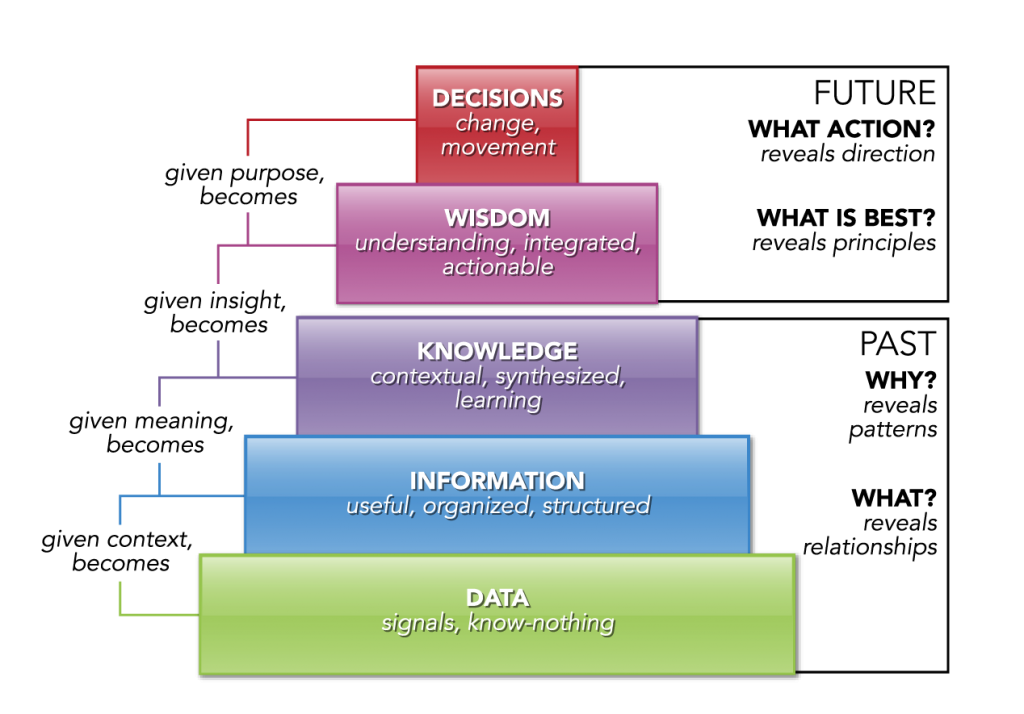
Source: http://www.pursuant.com/blog/tag/dikw-model/

